
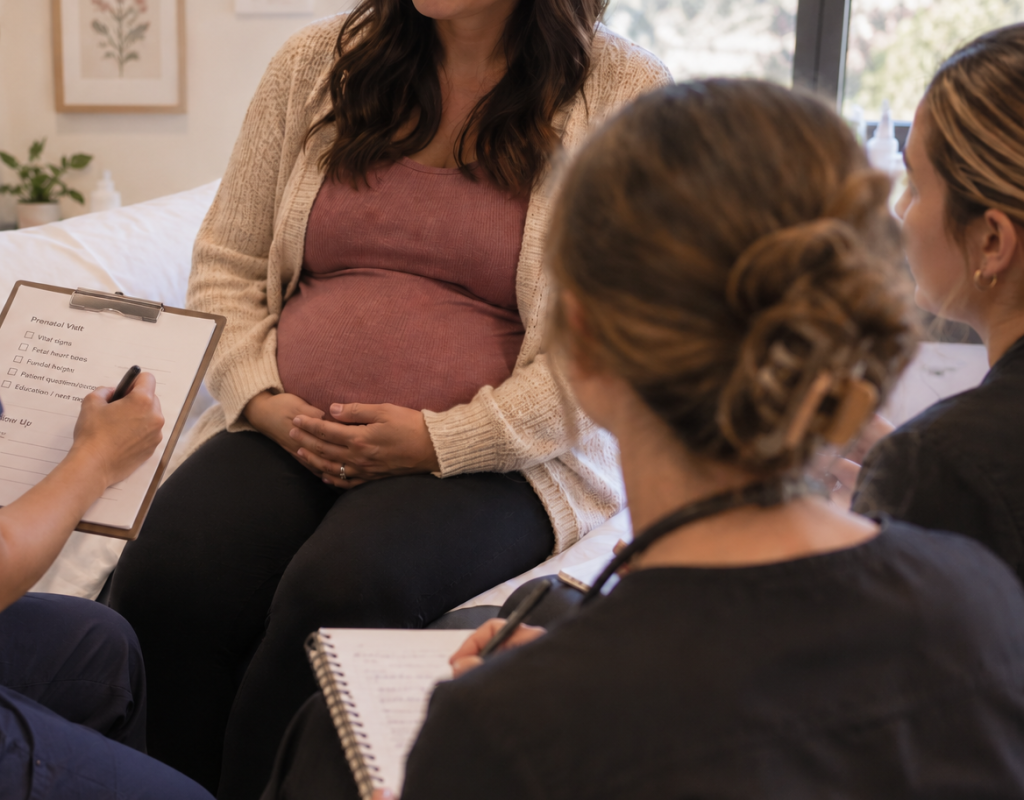
This summer was especially meaningful to me because I had the privilege of welcoming midwives from Poland to my practice here in Buckeye, Arizona.
For me, midwifery has never been simply a profession. It is a calling, a lifelong path of learning, service, mentorship, and sharing knowledge with other women who have chosen to dedicate their lives to supporting mothers and babies.
So when I had the opportunity to mentor and train Polish doctorate students who were developing their professional skills and preparing to become midwives, I welcomed them with an open heart.
Bringing generations of midwifery knowledge together
My own journey in midwifery began in Poland. I started working with women in 1993 in a hospital setting, including in the pathology of pregnancy, and completed my midwifery education in 1997. Over the years, my path took me from European hospital practice to home birth, water birth, traditional midwifery, and eventually to practicing as a Certified Professional Midwife and Licensed Midwife in Arizona.
Today, after decades of experience and having worked with more than 3,000 women, I feel a deep responsibility to pass what I have learned to the next generation of midwives.
That is why having these students with me was so special.
They came with an academic background, knowledge, questions, curiosity, and their own experiences. My role was not simply to lecture them. I wanted them to see what midwifery looks like when knowledge, observation, clinical judgment, compassion, intuition, and respect for the mother come together.
Training a midwife is about much more than learning what to do during labor.
It is learning how to observe.
How to listen carefully.
How to recognize when something is normal and when something requires attention.
How to communicate with a mother without taking away her confidence.
How to understand the physiology of birth while remaining prepared for complications.
And perhaps most importantly, how to know the boundaries of your own knowledge and when another level of medical care is necessary.
Mentoring future midwives
During our time together, I shared many years of practical experience with them.
We talked about prenatal care, labor, birth, postpartum care, newborn assessment, emergency preparedness, informed choice, communication with families, and the importance of individualized care.
But I also wanted them to understand something that cannot be learned entirely from a textbook: the relationship between the midwife and the woman.
Every woman brings her own history, fears, expectations, culture, family, and understanding of birth.
A good midwife does not approach every woman with exactly the same formula.
We have knowledge and protocols, but we also have to be present.
We have to observe the woman in front of us.
We have to ask questions.
We have to listen.
We have to explain.
And we have to respect her right to participate in decisions about her own care.
That is one of the things I emphasized throughout their training.
My hope is that these students will take what they learned here and continue developing their own voices as midwives. I want them to become professionals who are confident enough to use their knowledge, humble enough to continue learning, and compassionate enough to remember that every birth involves a real woman, a real baby, and a real family.
Evidence-based midwifery matters to me
My approach to midwifery is holistic, but holistic does not mean abandoning evidence or professional standards.
Quite the opposite.
I believe a good midwife must continue learning throughout her entire career.
As a Licensed Midwife in Arizona, I work within the requirements of Arizona’s midwifery laws and regulations. Arizona rules address areas including appropriate client selection, informed consent, risk assessment, emergency planning, consultation, transfer of care, documentation, and continuing education. The state’s midwifery framework also requires midwives to recognize circumstances that are outside their scope and to obtain appropriate consultation or transfer care when necessary.
For me, evidence-based practice means bringing together three important things:
The best available evidence.
Professional clinical knowledge and experience.
The individual needs, values, and informed choices of the woman.
I don’t believe that being a natural or traditional midwife means ignoring modern knowledge. My background has given me experience with both worlds, and I value what each can teach us.
My education has continued throughout my career. I have pursued additional training in home birth, water birth, breech and twins, Spinning Babies, newborn resuscitation, counseling, education, and other areas of midwifery practice. I also maintain ongoing education because a midwife’s responsibility does not end when she receives her certification or license. Beloved Birth’s professional background reflects this commitment to continuing education and midwife training in both the United States and Poland.
Arizona also requires licensed midwives to complete continuing education designed to strengthen their ability to practice within their scope, recognize situations outside their scope, and guide clients toward additional services when needed.
This is important to me personally.
I don’t want to stop learning.
And I don’t want the midwives I mentor to stop learning either.
Why I put so much effort into educating other midwives
Some people have asked me why I spend so much time teaching other midwives when I could simply focus on my own practice.
The answer is simple:
Because the future of midwifery depends on education.
Every midwife I teach has the potential to support hundreds of women throughout her career.
When I share something I have learned through decades of experience, I am not simply helping one student. I am helping that knowledge travel forward to the mothers and babies she will eventually serve.
That is a responsibility I take seriously.
I want midwives to learn from one another rather than competing with one another.
I want experienced midwives to share what they know with younger midwives.
I want students to feel comfortable asking questions.
I want us to discuss difficult births, unexpected situations, clinical decision-making, communication, and the emotional realities of this work.
And I want midwives to understand that asking for help is not weakness. It is professionalism.
From Poland to Arizona—and back again
There is something beautiful about being able to bring together the midwifery traditions of Poland with my experiences practicing here in Arizona.
I am bilingual in English and Polish, and my European roots remain an important part of who I am as a midwife.
Hosting Polish doctoral students this summer felt like a full-circle moment for me.
I began my own midwifery journey in Poland.
I built my experience there.
I continued my education and practice after coming to the United States.
And now I have the opportunity to welcome future midwives from Poland and share what I have learned along the way.
This is how knowledge grows.
One midwife teaches another.
One generation passes experience to the next.
And eventually, those students go out into the world and use what they have learned to care for women and babies.
My hope for the next generation
I hope the midwives I mentor will always remember that this work is both a privilege and a responsibility.
Be curious.
Never stop learning.
Know the evidence.
Know when to transfer.
But also remember the human being standing in front of you.
Birth is not just a clinical event.
The woman giving birth deserves to be heard. She deserves honest information. She deserves respect. She deserves an educated professional who can recognize normal physiology while remaining prepared for the unexpected.
That is the kind of midwife I have tried to become throughout my own journey.
And that is the kind of midwife I hope to help cultivate through my teaching.
This summer, I did more than host students from Poland.
I had the joy of sharing my experience with the next generation of midwives.
And for me, that is one of the most meaningful parts of being a midwife.